.png)

.png)


8 Science Ice breaker Activities for back to School Season

Updated: Jul 8

I’ll be honest: I hate icebreakers.
Not all of them, but definitely the kind where you have to stand in front of a room full of people and suddenly introduce yourself, share three fun facts, or pretend you are completely comfortable being the center of attention.
As an introvert, those moments always make me feel like I suddenly need to use the bathroom at the exact second the icebreaker begins.
And because I know that feeling so well, I try not to put my students in that position either.
Because the truth is, some of them feel the same way.
That does not mean we skip community-building altogether. It just means we choose activities more carefully. The best icebreakers for science class do not have to be cheesy, awkward, or overly personal.
They can be low-pressure, student-safe, and still help students talk, think, collaborate, and begin seeing themselves as part of a classroom community.
So if you are looking for science icebreakers that actually feel purposeful, here are some of my favorite non-cringe activities for middle and high school science students.


I love a good Fact or Fiction game, especially when the answers are not too obvious.
Those are the best ones.
Because once students realize that a science “fact” can sound completely made up, or that something they have always believed is not actually true, the discussion gets so much better.
For example, a statement like “A day on Venus is longer than a year on Venus” sounds like fiction, but it is actually true. That is the kind of question that makes students pause, argue a little, defend their thinking, and then want to know why.
And that is exactly what makes this such a great science icebreaker.
Instead of putting students on the spot with personal questions, this activity gets them talking about ideas. It gives them something to discuss, debate, and rethink together, which makes it perfect for building collaboration and critical thinking without making anyone feel awkward.
I also have a chemistry version of this game if you're interested.

Science Emoji Pictionary is one of those science icebreakers that feels light and fun, but still has students doing real thinking.
Students are given a set of emojis, and they have to work together to figure out the science term or concept being represented. It might be a vocabulary word, a piece of lab equipment, a process, or even a topic they will learn later in the year.
For example, 🧊💧🔥 could represent states of matter, or 🌱☀️💧 might represent photosynthesis.
What I like about this activity is that students are not just guessing randomly.
They have to look at the clues, talk through what each emoji could mean, and rationalize their answer as a group.
That is exactly the kind of low-pressure conversation I want happening at the start of the year.
Just like Science Fact or Fiction, this activity works well because the focus is not on personal sharing. Students are not being asked to stand up and talk about themselves. They are simply solving a puzzle together. At the same time, they are reviewing science vocabulary, practicing reasoning, and beginning to build teamwork.
I also have a Chemistry Version of this icebreaker here!

This is a science twist on the classic Two Truths and a Lie icebreaker.
But instead of asking students to come up with personal facts about themselves, which can feel awkward for some students, you give them three science-related statements. Two are true, and one is false.
Students then have 30 seconds to discuss with their group and decide which statement is the lie.
I really like this one as a whole-class activity, especially during the first week of science. It builds excitement quickly because students usually have strong opinions about their answers. Even better, they have to defend their thinking.
This activity is also a great way to spot student misconceptions in a low-stakes way.

This one is definitely one of my favorites because it almost always leads to really good discussion.
I got the idea from Jubilee Media’s Spectrum videos, where people respond to a statement by physically placing themselves along a line based on how much they agree or disagree.
I thought it would translate really well into a science classroom, especially for topics where there is not always one neat answer.
In this version, students are given ethical dilemmas or opinion-based prompts related to science. Instead of simply writing a response, they physically move to a part of the classroom that matches their stance.

For example, you might ask students to respond to a statement like:
“Genetically modified organisms should be used in food production.”
Or:
“Animal testing is justified when it leads to medical advancements.”
Students then move to the area of the room that best represents their opinion. Depending on your classroom space, you can use several categories such as strongly agree, agree, somewhat agree, disagree, and strongly disagree, or you can keep it simple with just agree and disagree.
What I like about this activity is that it gives students a chance to think before they speak. They are not just blurting out opinions. They have to choose a position, talk with others who chose a similar stance, and explain the reasoning behind their thinking.
This works especially well with older students because they are often ready to wrestle with more complex questions. It also helps them see that science is not just facts, definitions, and formulas. Science connects to real decisions, real people, and real-world consequences.

Science Taboo is a little more high-energy than some of the other activities on this list, but it is still a great team-building option.
In this game, students have to get their teammates to guess a science term without using the obvious words.
For example, if the term is photosynthesis, the taboo words might be plant, sunlight, and chlorophyll. So now students have to think carefully about how else they can explain the idea.

That is what I love about this activity. It pushes students beyond simply memorizing definitions. They have to describe concepts in their own words, listen carefully, make connections, and think quickly as a team.
It also works well because students can play in groups, so the pressure is not all on one person for too long.
Build rapport among your students with Concentric Circles, an activity where students discuss low-pressure getting-to-know-you questions in rotating pairs.
I like this one because students only have to talk to one person at a time, which feels much safer than speaking in front of the whole class. The questions are also intentionally light. No one has to share their deepest fear, explain their personality, or come up with a “fun fact” on the spot.
Instead, the questions are designed to feel safe, easy to answer, and just interesting enough to get students talking. That makes this activity a lot less cheesy than many traditional icebreakers while still helping students build rapport with their classmates.

This is one of those activities that gets students moving while still teaching them something they actually need to know.
Instead of standing at the front of the room pointing to equipment and saying, “This is a beaker, this is a graduated cylinder, this is a tripod stand,” students work in teams to solve clues and locate the apparatus themselves.
I like this because it helps students become familiar with the lab space in a much more active way. They are not just learning the names of equipment.
They are figuring out where things are, what they look like, and how to navigate the room before they are expected to use those items in a real lab.

In this scavenger hunt, students solve 12 riddle-style clues to find different pieces of lab apparatus. When they locate each item, they copy down a code. Once all the codes are collected, students use them to solve a cryptogram that reveals a science slogan or message.
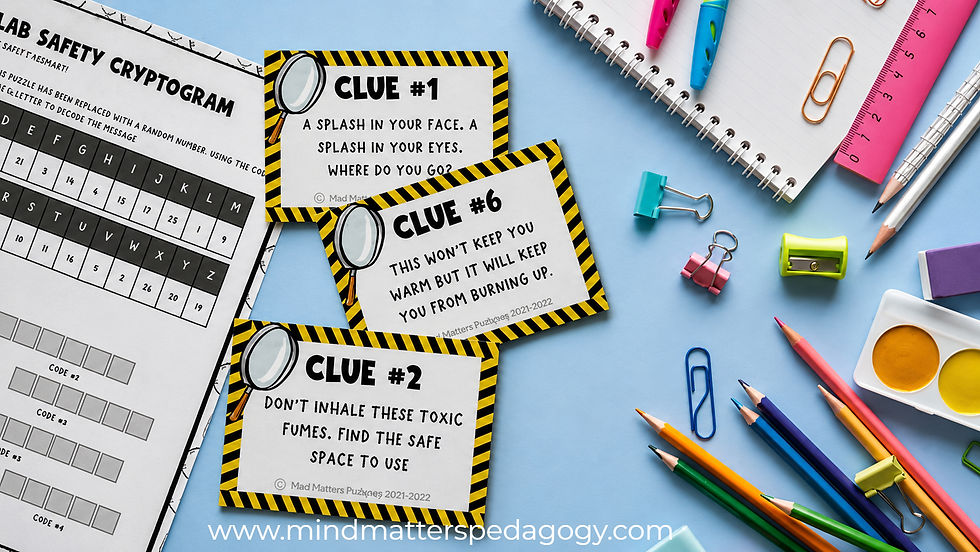
There is also a Lab Safety Scavenger Hunt version of this activity. Instead of hunting for lab apparatus, students locate important safety equipment such as the fire extinguisher, eyewash station, safety goggles, and personal protective equipment.
This version is a great way to introduce or review lab safety without turning it into a lecture. Students still work in teams, solve clues, move around the room, and become familiar with the safety features they need to know before beginning experiments.

This is a fun science twist on the classic Guess Who game.
Each student is assigned a famous scientist profile, and their goal is to figure out their partner’s mystery scientist by asking yes-or-no questions.
What I like about this activity is that students are not just guessing names. They have to ask thoughtful questions like:
“Did your scientist work in physics?”
“Did they study living things?”
“Are they known for an invention?”
“Did their work involve space?”
It gets students thinking about scientific fields, discoveries, and contributions in a way that feels like a game instead of a research task.
It is also a great first-week activity because students are talking, reasoning, and working together without having to share personal information about themselves.
This activity helps students learn about scientists while practicing logical thinking and science vocabulary. It is low-pressure, interactive, and perfect for building classroom discussion without making students feel put on the spot.
Final Thoughts
Starting the school year with these icebreakers can set a positive tone for the months ahead. They not only help students get to know each other but also foster a collaborative and engaging learning environment. Adapt these activities to fit your classroom needs and watch as your students bond and grow together through the exciting world of science.


socolive.movie giúp tôi quan sát sự kết nối giữa nội dung bóng đá trực tiếp và những thông tin bổ trợ được cung cấp trên website. Sau khi chọn trận đấu, người dùng có thể muốn đọc tin tức, kiểm tra kết quả hoặc tìm hiểu thêm về tình hình của các đội bóng. Tôi chú ý xem những chuyên mục này có tên gọi dễ hiểu và đường dẫn chuyển tiếp có được đặt ở vị trí thuận tiện hay không. Nếu cấu trúc điều hướng nhất quán, việc tra cứu thêm sẽ ít bị gián đoạn. Tôi cũng quan tâm đến cách trình bày tiêu đề bài viết để người đọc biết nội dung trước khi mở trang. Tuy…
https://gtgroup.ru.com/ khiến tôi chú ý đến khả năng hỗ trợ người dùng khi cần tìm lời giải đáp cho một vấn đề cụ thể. Tôi thường xem khu vực trợ giúp có phân chia câu hỏi theo chủ đề hay không, đặc biệt với các nội dung liên quan đến tài khoản, giao dịch và điều khoản sử dụng. Những hướng dẫn về đăng nhập, nạp rút và quản lý hồ sơ nên được viết riêng để tránh trộn lẫn các quy trình. Tôi cũng quan tâm đến việc thông tin liên hệ có dễ tìm và nội dung trả lời có trực tiếp giải quyết câu hỏi hay không. Một khu vực hỗ trợ được tổ chức tốt có thể…
FLY 88 khiến tôi chú ý đến khả năng tìm trợ giúp khi người dùng gặp vấn đề trong quá trình sử dụng. Tôi tìm khu vực hướng dẫn, sau đó xem nội dung về đăng nhập, giao dịch và cách truy cập trò chơi được phân nhóm như thế nào. Một hệ thống hỗ trợ dễ dùng cần có tiêu đề cụ thể, câu chữ trực tiếp và chỉ dẫn giúp người đọc xác định bước tiếp theo. Nếu câu trả lời nằm sâu hoặc diễn đạt mơ hồ, việc tìm thông tin sẽ kéo dài. Tôi cũng phân biệt nội dung hướng dẫn có sẵn với chất lượng phản hồi thực tế từ bộ phận hỗ trợ. Với tôi,…
https://gk88.day/ là nơi tôi xem xét cách phân biệt các trò chơi bài và những hình thức xổ số được giới thiệu. Khi tìm các tên như Tiến lên, Phỏm, Mậu Binh hoặc Poker, tôi chú ý liệu mỗi trò có nhãn riêng và phần mô tả đủ để nhận diện hay không. Với xổ số ba miền và các dạng trực tuyến khác, cách phân chia theo loại hình hoặc khu vực có thể giúp người đọc tìm đúng nội dung nhanh hơn. Tôi cũng xem kết quả và thông tin liên quan có được trình bày theo trật tự dễ đối chiếu hay không. Nếu cách phân loại thiếu nhất quán, việc chuyển giữa các nhóm sẽ khó theo…
TN88.COM khiến tôi chú ý khi bắt đầu kiểm tra cách trang chủ tổ chức thông tin. Tôi quan sát khu vực đăng nhập, tài khoản và hỗ trợ trước để hình dung các chức năng chính, sau đó mới chuyển sang thể thao, casino và bắn cá. Các danh mục được phân chia tương đối rõ nên tôi dễ nhận biết từng khu vực khi thao tác. Tôi cũng thử quay lại trang chủ sau vài lần chuyển mục để xem vị trí điều hướng có dễ ghi nhớ không. Cách bố trí các thành phần quen thuộc giúp tôi không phải tìm kiếm lại quá nhiều. Qua trải nghiệm, tôi đánh giá giao diện có hướng sắp xếp khá…