.png)

.png)


7 Science Classroom Routines That Save Time and Improve Classroom Management

Updated: Aug 28
A classroom procedure can look excellent during the first week of school and still disappear before the end of the first term.
I have created systems that seemed perfectly organized on paper: carefully assigned laboratory roles, elaborate rotation charts, labelled displays, and procedures that depended on students—and me—remembering several small steps.
Some worked for a while. Others slowly became classroom decoration.
The problem was not necessarily that the ideas were bad. They simply required more maintenance than the problem justified.
Now, when I introduce a classroom routine, I consider whether it will still be manageable during a busy laboratory week, a heavy marking period, or the final month of school.
In a science classroom, the best routines are not always the most impressive. They are the ones that reduce unnecessary questions, protect instructional time, support laboratory safety, and help students become more independent.
These are the routines I find most useful throughout the school year.
1.Give Students Somewhere to Look as Soon as They Enter
Students should not have to wait for the teacher to tell them how to begin every lesson.
When students enter my classroom, the instructions for the day are already displayed.
I use daily slides to show the warm-up, materials students need, the lesson focus, important reminders, and any assignments that must be submitted.

The design and content may change, but the location and general structure remain familiar.
Students quickly learn to look at the screen before asking:
“What are we doing today?”
“Do we need our notebooks?”
“Are we doing a lab?”
“Is anything due?”
This does not eliminate every question, of course. However, it gives me a consistent place to redirect students.
Instead of repeating the instructions individually as they enter, I can simply say, “Check today’s slide.”
The routine also helps students settle more quickly. They can collect the correct materials, begin the warm-up, and prepare themselves for the lesson while I take attendance or handle other beginning-of-class responsibilities.
A good entry routine should answer the most predictable questions before students need to ask them.
Use Warm-Ups to Create a Calm Start
A daily warm-up can do more than review yesterday’s lesson. It can create the transition students need between the hallway and the science classroom.
I prefer warm-ups that students can begin independently without a long explanation. These may include a retrieval question, a diagram to interpret, a short calculation, a scientific claim to evaluate, or a brief data-analysis prompt.
In chemistry, I also use short bellringer questions from my Math Readiness for Chemistry materials.

Students might complete a metric conversion, rearrange a simple formula, interpret a graph, review significant figures, or solve a ratio problem.
These questions help reinforce the mathematical skills students need for chemistry without turning every lesson into a separate mathematics lesson.
A few minutes of consistent practice can also reveal misunderstandings before they create larger problems during topics such as density, concentration, gas laws, or stoichiometry.
The warm-up does not need to be collected and graded every day. Its value often comes from the routine itself. Students enter, look at the daily slide, begin working, and understand that class has started.
Create a Clear Routine for Absences
Student absences can create a surprising amount of disruption.
A student returns while you are setting up a demonstration, helping another student, checking equipment, or trying to begin the lesson. The student understandably wants to know what was missed, but the beginning of class is rarely the best time to provide an individual summary of several lessons.
At the beginning of the year, I explain that lesson materials, assignments, slides, and important announcements will be posted on our learning management system whenever possible. Students are expected to check the LMS before asking me to reconstruct everything they missed.
My response is usually straightforward:
“Welcome back. Please check the LMS first. After you have reviewed what was posted, come to my office or email me if you still have questions.”
The intention is not to avoid helping students. It is to give them a logical first step.
Students will forget occasionally, especially early in the year. Consistency matters. When the response remains the same, students gradually become accustomed to checking the LMS before approaching the teacher.
Science classes require some flexibility because not every missed experience can be recreated.
A laboratory may involve prepared solutions, specialized equipment, perishable materials, group observations, or significant setup time.
Depending on the purpose of the activity, an absent student might analyze class data, complete an alternative task, watch a demonstration, use provided results, or complete a modified version of the investigation.
The expectation should be clear, but it should also reflect the practical realities of laboratory teaching.
Make Preparation Part of Laboratory Participation
Many laboratory management problems begin before students enter the laboratory.
When students see the procedure for the first time while standing at the bench, the beginning of the practical becomes a stream of questions:
“How much do we measure?”
“What happens after this step?”
“Are we supposed to heat it now?”
For major investigations, I provide the method in advance and require students to turn it into a flowchart or concept map before the laboratory session.
The preparation is not graded for appearance, but it must demonstrate that the student has processed the sequence of the investigation.
Students who arrive without it complete the preparation before joining their groups.
This is not intended as a punishment.
It protects the student, the group, and the limited laboratory time available. An unprepared student may skip an important step, mishandle equipment, rely entirely on classmates, or slow down the group while the procedure is explained again.
When an investigation involves hazardous chemicals or unfamiliar techniques, I may also give a short pre-lab quiz.
Questions focus on the safety decisions students must make: personal protective equipment, chemical hazards, disposal methods, emergency responses, and critical stages of the procedure.
Preparation should not be treated as an optional extra. It is part of participating safely and meaningfully in practical science.
Control How Equipment Is Collected
Unstructured movement during experiments can create unnecessary confusion in a school lab.
If every student begins walking around the room collecting equipment, the result is often congestion, missing materials, duplicated supplies, and students gathering items they do not yet need.
Before the activity, I decide which materials will already be placed at the stations, which supplies will be collected from a central area, and who from each group is permitted to collect them.
My Prinatable Science Teacher Planner helps me to work all this out before lab day as it includes unique pages for lab preparation and set up.

Students also need to know what to do when something goes wrong.
Where should damaged glassware be placed?
Which materials can be washed in the sink?
Which substances require a specific disposal container?
A direction such as “Clean your station” is too vague for many laboratory activities. Students need an observable definition of what completion looks like: chemicals disposed of correctly, glassware rinsed, equipment returned, benches wiped, sinks cleared, and stools placed safely.
Cleanup instructions should be given before students begin cleaning—not while materials are already being poured away or carried across the room.

Keep Group Roles Flexible but Expectations Clear
Defined group roles can be useful, but not every investigation requires a complicated rotation system.
Some practical activities benefit from assigning a materials manager, recorder, timer, or equipment operator. In other investigations, the tasks change so frequently that fixed roles feel artificial.

Rather than forcing the same role cards onto every activity, I focus on the responsibilities students must share.
One student may record the data, but every group member should understand what the data mean.
One student may collect the equipment, but the entire group is responsible for returning it correctly.
Students should also understand that productive disagreement is expected in science. They may question a result, compare measurements, challenge an explanation, or suggest that a step be repeated.
Useful scientific discussion might sound like:
“Which evidence supports that conclusion?”
“Our measurements are different. Can we check the method?”
“Could there be another explanation?”
“Let us repeat that measurement before we decide.”
The goal is not a silent laboratory. The goal is purposeful discussion in which students challenge ideas without dismissing one another.

Related: Get Students speaking like Scientists with this Bulletin Board kit
Teach Students What to Do When They Finish Early
“What do I do when I’m finished?” is one of those questions that can interrupt a lesson repeatedly unless students already know the answer.
In science, the first step is checking whether the work is genuinely complete.
A student may have calculated an answer without including a unit, drawn a graph without labelling the axes, recorded data without checking significant figures, or written a conclusion without referring to evidence.
Before moving on, students complete a quick quality check appropriate to the task.
After that, they may choose from a small collection of independent science activities. I keep the options simple and familiar so that students do not need another set of instructions.
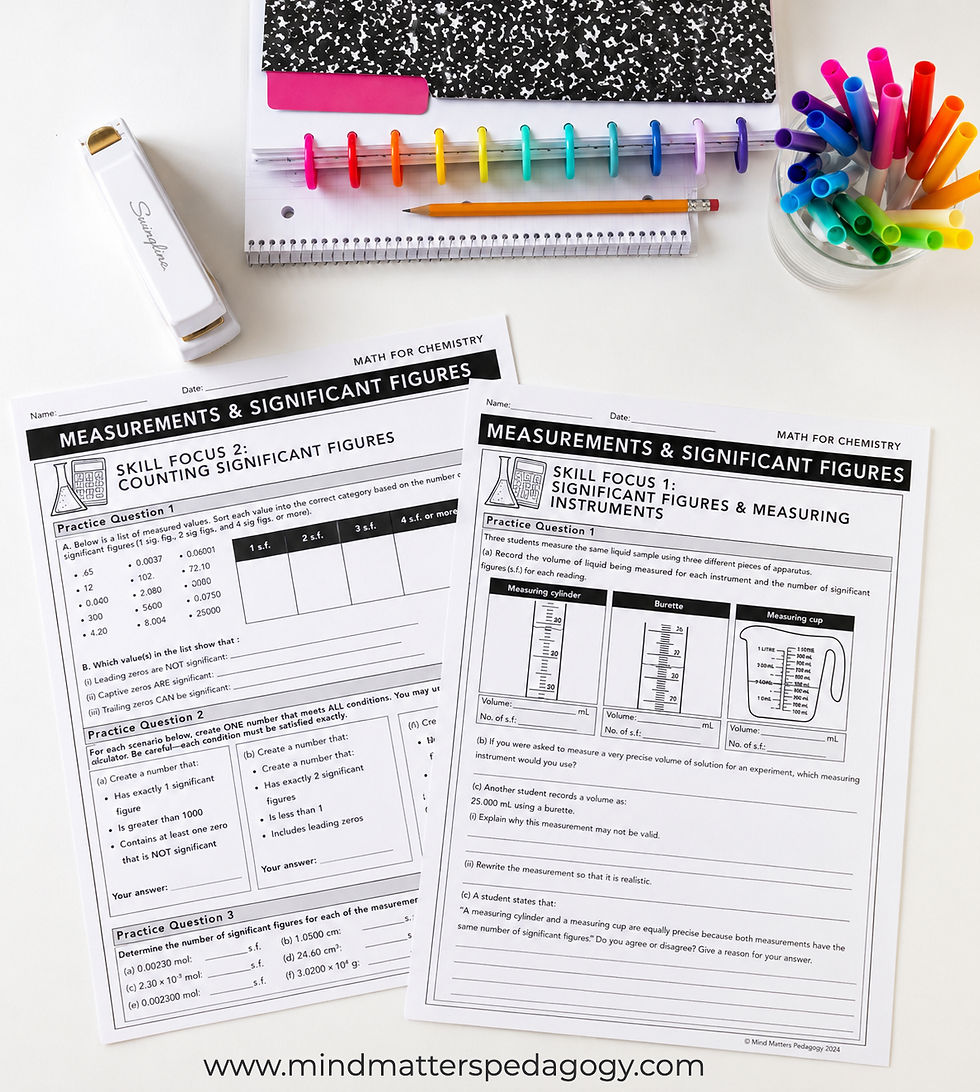
For students who need additional mathematical practice, I may direct them to a Math Readiness for Chemistry Targeted worksheet.
These provide useful review of skills such as unit conversions, ratios, graphing, formula rearrangement, scientific notation, and significant figures without me having to take time from an already packed schedule to reteach math topics.
These activities work well because they are easy to begin, easy to pause, and do not require additional setup. They also feel more purposeful than giving students random busywork simply because they completed the main task efficiently.
The objective is not to reward fast workers with more compulsory work. It is to give students meaningful choices that keep the classroom calm while others finish.
Practise the Routines That Matter Most
Explaining a procedure is not the same as establishing it.
During the first weeks of school, students need opportunities to practise the routines they will use repeatedly: entering the classroom, locating instructions, beginning the warm-up, collecting equipment, reporting a safety problem, submitting work, cleaning a station, and finding missed assignments.
This can feel like time taken away from content, particularly when the curriculum is already demanding. However, the time is usually recovered throughout the year.
A class that knows how to begin independently settles more quickly.
Students who check the LMS require fewer individual explanations.
Groups that understand the equipment procedure begin practical work sooner.
Students who know what to do when they finish are less likely to distract others.
When a routine begins to weaken, it may need to be retaught. That is not evidence that the procedure has failed. It is a normal part of maintaining classroom expectations.
Build Systems for Your Busiest Weeks
When I consider introducing a new classroom system, I ask myself whether it will work under less-than-ideal conditions.
Will I maintain it during a week with several laboratory preparations?
Will students understand it when someone has been absent?
Does it solve a frequent classroom problem?
A good classroom procedure should reduce work over time. It should not become another display to update, chart to manage, or elaborate system to remember.
Some of the most effective routines in my classroom are also the least complicated: a daily slide displayed as students enter, a familiar warm-up, one place for missed work, a pre-lab flowchart, a clear cleanup checklist, and a small set of independent activities for students who finish early.
They may not be the most decorative classroom systems.
But they continue working when the school year becomes busy—and that is what makes them valuable.



Comments