.png)

.png)


9 No-Prep Science Warm-Ups and Bell Ringers for Middle and High School


The first five minutes of science class have a way of disappearing.
Students are coming through the door. Someone needs a pencil. Someone else wants to know whether yesterday’s assignment was due today. You are taking attendance, opening your slides, checking that the lab materials you set out are still where you left them, and trying to redirect the conversation happening three feet from the door.
Meanwhile, half the class is sitting there waiting for something to happen.
This is one reason I like having a few science warm-ups that I can pull out without much thought.
And I do mean a few.
I don't think teachers need 180 completely different bell ringers or another workbook that has to be printed, collected and graded. In fact, I have found that the opposite is often more useful: a small collection of familiar activities that students already know how to do.
Put one on the board. Give students three or four minutes. Discuss it briefly. Move on.
The trick is choosing science bell ringers that give students something worthwhile to think about.
Instead of another set of recall questions, I tend to prefer prompts that ask students to notice something, make a prediction, spot a mistake, classify information or defend an answer.
Here are nine that work particularly well in middle and high school science.
What Makes a Good Science Warm-Up?
Before we get to the list, I should probably clarify what I mean by a good warm-up.
It does not have to assess the entire lesson from yesterday.
It does not have to be graded.
And it definitely does not have to become a fifteen-minute activity that quietly eats into your planned lesson.
For me, the best science warm-ups are activities students can start with very little explanation and finish in roughly five to ten minutes.
Depending on the day, I might use one to:
retrieve something we learned last week;
expose a misconception before starting a new topic;
introduce an interesting phenomenon;
review scientific vocabulary;
get students explaining their reasoning;
give students something productive to do while everyone settles;
or simply change the energy in the room.
Notice that those aren't all the same job.
Your warm-up doesn't have to accomplish everything.
That is also why I like rotating different formats instead of giving students the same type of question every morning.
So with that in mind, here are nine science class starters worth adding to your rotation.
1. Start With a Notice and Wonder Science Warm-Up
This might be the easiest science warm-up on the list.
Put something interesting on the board.
Don't explain it yet.
It could be a photograph, graph, diagram, short video clip, unusual lab setup, or scientific phenomenon.
Then ask:
What do you notice?
What do you wonder?
Simple, yes. But there is more going on here than it first appears.
Students have to slow down long enough to distinguish between what they can actually observe and what they think is happening.
For example, you could display:
condensation on the outside of a cold glass;
a plant growing toward a window;
two liquids forming separate layers;
a graph with an unexpected pattern;
an unusually shaped rock formation;
a close-up image of an unfamiliar organism;
or a demonstration setup students haven't seen before.
One thing I would resist is answering every question students generate.
You don't have to.
Sometimes the point of a Notice and Wonder is simply to get students looking closely enough to realize that there is something worth exploring.
Push Students Beyond Simple Observations
With older students, I like taking this one step further.
Instead of only asking What do you notice? Have students separate their thinking into:
What I observe
What I infer
What I still need to know
That small change can lead to some surprisingly good conversations about evidence.
A student might write, “The liquid is boiling.”
But can they actually observe boiling? Or are they observing bubbles and inferring what those bubbles mean?
That distinction between observation and interpretation comes up everywhere in science, so it is worth practicing long before students meet it on a formal assessment.
2. Use Science Fact or Fiction to Uncover Misconceptions
I love a good science statement that sounds just believable enough to cause trouble.
That is essentially the whole idea behind Science Fact or Fiction.
Display a statement and ask students to decide whether it is true or false.
For example:
Lightning never strikes the same place twice.
Most students will have an immediate reaction.
Some will be certain it is true because they have heard the saying before. Others will know it is false. A few will look around the room hoping someone's facial expression gives away the answer.
But the vote isn't really the interesting part.
Ask:
Why did you choose that answer?
Then, if you want to push the thinking a little further:
What evidence would convince you that you were wrong?
Now you have something much more useful than a true-or-false question.

Don't Reveal the Answer Too Quickly
This is where I think Fact or Fiction can either become a genuinely useful science warm-up or just another trivia game.
Give students time to commit to an answer first.
Let them compare with a partner.
Ask someone from each side to explain their reasoning.
Then reveal the answer.
These prompts are especially useful at the beginning of a unit because they expose ideas students are already carrying around about topics like:
matter;
forces;
energy;
the human body;
animals;
space;
weather;
laboratory safety;
and scientific claims they encounter online.
Sometimes those ideas are accurate.
Sometimes they are very much not.
Either way, you find out before you start teaching.
My Science Fact or Fiction activity includes ready-to-display science statements designed to sound plausible enough to make students stop and think, along with explanations you can use during the reveal.
Want a ready-to-use version? Take a look at Science Fact or Fiction.
3. Try a Science Odd One Out Bell Ringer
Give students four related things and ask one question:
Which one doesn't belong?
That's it.
Except there may not be only one answer.
Suppose you display:
hurricane;
volcano;
earthquake;
fault.
Hurricane is an obvious choice because it is primarily an atmospheric event while the others are associated with geological processes.

But the real value of Odd One Out starts when students begin noticing other possible relationships.
That is why I don't like Odd One Out questions where one answer is so painfully obvious that the discussion is over in ten seconds.
The best sets have some ambiguity.
Students should have to decide what characteristic matters and then defend that decision.
Make Students Defend Their Classification
A simple response frame helps:
I think ______ is the odd one out because ______. The other three are connected because ______.
Once students get comfortable with the routine, take away the frame.
Then start making the challenge harder.
Ask them to:
find a second defensible answer;
regroup the items in another way;
identify the scientific property they used to classify them;
challenge someone else's answer;
or suggest a fifth item that would fit the group.
This works across almost every science course because the items can be terms, images, equipment, graphs, substances, processes or phenomena.
And the nice thing is that you can make the reasoning as sophisticated as your students can handle.
My Science Odd One Out resource includes visual prompts designed to allow more than one scientifically defensible answer instead of relying on an obvious outlier.
If this sounds like something your students would enjoy, you can find the full activity here.
4. Ask Students to Draw a One-Minute Scientific Model
Not every warm-up needs to involve writing.
Sometimes I would much rather see what students think is happening.
Give them one or two minutes and ask them to sketch a scientific process, structure or system, from memory.

You might ask students to:
draw particle arrangements in a solid, liquid and gas;
show what happens to particles when a substance is heated;
model what they think is happening when something dissolves;
draw the path of blood through the heart;
show how energy moves through a food chain;
draw the forces acting on a stationary object;
or sketch the water cycle.
The drawings don't have to be pretty.
Actually, I would make that very clear.
You're not looking for artistic ability. You are trying to see how students are representing the science in their heads.
And that can tell you quite a lot.
Let Students Revise Their Models
This activity becomes much more interesting if students return to the same model later.
After a demonstration, reading, discussion or lesson, have students look back at their original sketch.
Then ask:
What would you change now?
Students can add or remove something using another colour.
Now the warm-up has become a visible record of how their thinking changed.

You can also display anonymous student examples and ask the class:
What does this model explain well?
What is missing?
What would you change?
Which parts are supported by what we observed?
I prefer those questions to simply asking whether a model is “right” or “wrong.”
5. Use a Science Riddle That Actually Requires Reasoning
I have a very specific opinion about science riddles.
They shouldn't just be definitions wearing costumes.
If the answer is mitochondria and the clue is essentially “I am the powerhouse of the cell,” we haven't really asked students to do much.
A better riddle gives several clues students have to connect.
For example:
I accompany every measurement, even when no mistake has been made. Better tools may make me smaller, but they cannot remove me completely. What am I?
The answer is uncertainty.
Students have to consider each clue and decide which scientific concept fits all of them.
That makes riddles useful for vocabulary review without turning the warm-up into “write the definition of…”

Make Students Use the Clues
Once students find the answer, don't automatically stop there.
Try asking:
Which clue gave it away?
Or:
Which answer did you consider first, and why didn't it work?
You can also have students:
underline the most useful clue;
add another clue;
rewrite one clue to make the riddle easier;
or create a riddle for a related term.
That last one is much harder than it sounds.
Writing a good clue requires students to understand the concept well enough to describe it without simply naming it.
My Science Riddles resource includes non-rhyming, clue-based riddles from biology, chemistry, physics, Earth science, ecology, space science, and general science, along with an optional scaffolded version for students who need more support.
Want to try this with your students? Check out my Science Riddles.
6. Use a Science Word Hunt for a Quick Brain Break
This one is lighter.
And I think that is okay.
Not every science warm-up needs to produce a paragraph of scientific reasoning.
Give students one large science word and ask them to create as many smaller words as possible using its letters.
For example:
PHOTOSYNTHESIS
Students might find:
photo
synthesis
photon
hot
spin
thin
ion
Give them 60 seconds.
Then ask who found a word no one else has.
You can also give bonus points for science-related words.
When I Would Use This One
I wouldn't use a Word Hunt when I'm trying to diagnose whether students understand photosynthesis.
That's not really what the activity does.
I would use it when:
students have been working intensely and need a change of pace;
I have a few awkward minutes between activities;
lab materials are being distributed;
some students have finished early;
we are waiting for technology to cooperate;
or I want to introduce a science term without immediately turning it into formal notes.
If the main word is unfamiliar, give students a quick student-friendly meaning before they start.
Then move on.
This is one of those activities that is useful partly because it is short.
My Science Word Hunt activity combines the 60-second challenge with vocabulary drawn from several science disciplines and works well as a class starter, early-finisher activity or science brain break.
If this sounds useful, I have a classroom-ready version here.

7. Find and Correct the Scientific Mistake
If you teach teenagers, you already know that telling them someone else got something wrong can be highly motivating.
Use that.
Put a scientific explanation, calculation, graph, diagram or procedure on the board with one deliberate error.
Then ask students to find it.
For example:
When a liquid freezes, its particles stop moving completely.
Or:
The dependent variable is the factor deliberately changed by the scientist.
Or show a diagram of someone reading the meniscus of a typical water-based liquid incorrectly.
Students have to identify the problem and correct it.
But don't let them stop at:
“That's wrong.”
Make them explain why.
Use the Mistake to Expose Misconceptions
A useful response structure is:
The mistake is ______. It should be ______ because ______.
You can do this with almost anything:
an incorrectly labelled diagram;
reversed graph axes;
a lab setup with a safety problem;
an unbalanced chemical equation;
a conclusion that does not match the data;
an incorrect measurement unit;
a particle diagram;
or a worked calculation with one bad step.
One of my favourite extensions is having students create the mistake themselves.
Tell them:
Write an incorrect explanation that might fool someone who only half understands this topic.
Now they have to think about the misconception as well as the correct science.
8. Use Science Would You Rather for Discussion and Movement
Science Would You Rather is another activity I don't think we need to over-academicize.
Sometimes it is just nice to get students talking.
Ask:
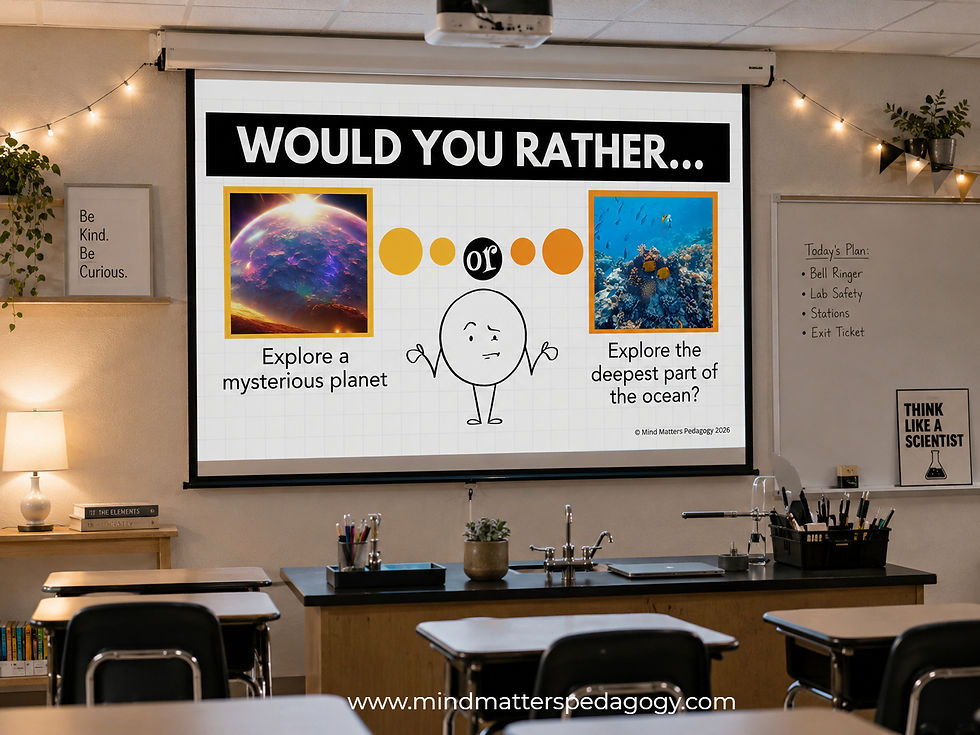
Would you rather explore a mysterious planet or explore the deepest part of the ocean?
Students choose.
Then defend the choice.
There may not be a correct answer, but students can still bring scientific knowledge into the argument.
And depending on how much time you have, this activity can take 60 seconds or ten minutes.
Change the Format to Fit the Day
For a very quick version, students hold up one finger for Option A and two for Option B.
If everyone has been sitting too long, have students move to opposite sides of the room.
Or pair students who chose different options and give each person 30 seconds to make their case.
One variation I especially like is allowing students to change sides after hearing the arguments.
Then ask:
What changed your mind?
That opens up a small but worthwhile conversation about evidence.
Changing your position when you encounter better information isn't losing. In science, that is often exactly what we should be willing to do.
My Science Would You Rather activity includes science-themed questions students can discuss, debate or use as movement breaks, including prompts that work well at the beginning of the year when students are still getting comfortable with one another.
9. Ask Students to Make a Prediction Before You Reveal What Happens
If I am doing a demonstration, showing a phenomenon, or beginning an investigation, this is probably the warm-up I would choose.
Ask students what they think will happen.
But add one important word:
Why?
Instead of:
What do you think will happen?
Try:
I predict ______ because ______.
You could ask:
Which object will reach the ground first?
Which material will transfer heat fastest?
What will happen when these substances are combined?
Which liquid will produce the greatest temperature change?
How will the graph change when this variable increases?
Which sample will have the greatest density?
What will happen to the balloon when the bottle is heated?
The goal isn't to see who can guess correctly.
The prediction gives students something to compare with the evidence.
Come Back to the Prediction
This is the part I wouldn't skip.
Afterward, return to what students wrote.
Ask:
What actually happened?
What evidence did we collect?
Did that evidence support your prediction?
What would you change about your original explanation?
What are you wondering now?
You have now connected the opening of the lesson to the end without creating a separate exit-ticket question.
Don't Use the Same Type of Science Bell Ringer Every Day
One reason bell ringers can start feeling stale is that we find one routine that works and then use it every single day.
There is nothing wrong with repetition. Predictable routines are useful.
But predictable doesn't have to mean identical.
I would rather have students become familiar with four or five formats and rotate them depending on what I need that day.
For example:
Day | Science Warm-Up | What It Does |
Monday | Fact or Fiction | Activates prior knowledge and exposes misconceptions |
Tuesday | Odd One Out | Compares, classifies, and justifies |
Wednesday | Science Riddle | Reviews vocabulary through reasoning |
Thursday | Notice and Wonder or Prediction | Launches the day's science |
Friday | Word Hunt or Would You Rather | Adds a lighter discussion or brain break |
And I wouldn't feel particularly obligated to follow that schedule perfectly.
If Tuesday's lesson starts with a demonstration, use a prediction.
If Thursday has been a very long week and everyone needs to stand up for five minutes, use Would You Rather.
The routine should serve the class, not the other way around.
Use Science Warm-Ups for Retrieval Practice Too
Another option is to occasionally ignore the day's topic altogether.
If you are teaching chemical reactions in November, there is no rule that every bell ringer has to be about chemical reactions.
Bring back density.
Put up a significant-figures question.
Show a particle diagram from the matter unit and ask students to interpret it.
Ask students to explain something you taught three weeks ago.
Bell ringers give you a convenient little pocket of time for bringing older learning back into circulation without announcing:
“Today we are reviewing Unit 1.”
This is where a simple retrieval question can be more useful than something elaborate.
The important part is being intentional about which older ideas are worth revisiting.
How to Keep Science Bell Ringers From Becoming More Work for You
A warm-up is supposed to make the beginning of class easier.
If your bell-ringer system requires you to print 30 pages every morning, collect them, grade them, enter scores and return them, something has gone wrong.
You do not have to grade everything students write.
I would go even further:
Please don't.
Give Students One Place to Respond
Instead of collecting separate sheets, students can use:
a dedicated warm-up notebook;
one weekly recording sheet;
the first section of their science notebook;
mini whiteboards;
reusable dry-erase sleeves;
or a digital response form when you actually need the data.
Pick something you can live with.
Stop Collecting Every Answer
Some days I want to see every student's response.
Most days I don't need to.
You can circulate while students work, glance at notebooks, stamp completed responses, ask students to self-correct, or listen to a few answers during discussion.
If a warm-up reveals a major misconception, then you have useful formative information.
You don't need a score out of ten attached to it.
Don't Hear From Every Student Every Day
This is another place where warm-ups can expand far beyond the five minutes you planned.
Let students compare responses with one person.
Call on two or three students.
Choose contrasting answers.
Move on.
If the conversation is exceptionally good and you have the time, keep going.
But you are allowed to stop a discussion while students still have something to say.
Put the Timer Where Students Can See It
A visible timer helps define what this activity is.
Three minutes feels like a warm-up.
Twelve minutes feels like we accidentally started another lesson.
Some of these activities can absolutely grow into longer discussions when you want them to. But on an ordinary day, keep the boundary clear.
Can These Science Warm-Ups Be Used as Brain Breaks?
Some of them can.
I wouldn't use the terms warm-up and brain break interchangeably, though.
A warm-up gives the beginning of class some structure and often prepares students for learning.
A brain break interrupts a longer stretch of work and changes what students are doing for a few minutes.
For science brain breaks, I would choose activities that require less writing and allow a little movement or conversation:
a 60-second Science Word Hunt;
Science Would You Rather;
a partner riddle;
a quick Fact or Fiction vote;
or an Odd One Out challenge completed with a group.
They still have a science connection, but they don't feel like another assignment disguised as a break.
Choose Science Warm-Ups That Get Students Thinking
I don't think the goal of a bell ringer should be to make every student look busy from the second they walk through the door.
Students are human. Teachers are human. Some days everyone needs a minute.
What I do want is a beginning-of-class routine that feels purposeful.
Sometimes that means retrieving something students learned three weeks ago.
Sometimes it means putting an odd photograph on the screen and letting them argue about what they think is happening.
Sometimes it means drawing particles.
Sometimes it means finding the mistake.
And sometimes it is Friday and a ridiculous Science Would You Rather question is exactly what the room needs.
The activity can be quick.
It can be fun.
It can even feel like a game.
But when possible, give students one more step beyond the answer:
Why?
What makes you think that?
What evidence supports it?
Could there be another answer?
That little bit of reasoning is usually where the science starts.
If you'd rather have several of these activities ready to display, you can explore my:
Each is designed for middle and high school science classrooms and can be displayed from Google Slides, so you can add a class starter without creating another worksheet to print and grade.
Frequently Asked Questions About Science Warm-Ups and Bell Ringers
How long should a science warm-up take?
For most classes, about three to seven minutes is plenty. If the prompt opens up a particularly useful discussion or leads directly into the lesson, you can let it run longer. The important thing is deciding whether the conversation is worth the extra time rather than allowing every warm-up to expand automatically.
Should science bell ringers be graded?
They don't have to be. In many cases, a quick notebook check, completion stamp, self-correction or short class discussion gives you all the information you need. Save formal grading for the warm-ups where you genuinely need individual assessment data.
What are good bell ringers for high school science?
High school students can handle the same basic formats as younger students, but the reasoning should be more demanding. Try Odd One Out prompts with multiple defensible answers, error analysis, scientific models, predictions that require evidence, misconception-based Fact or Fiction questions, and retrieval prompts from earlier units.
Can science warm-ups be used for retrieval practice?
Yes. A bell ringer does not have to review yesterday's material. Occasionally bring back ideas from earlier units and ask students to recall, apply, compare or explain them. This gives you a simple way to keep important concepts in circulation throughout the year.
What is the difference between a bell ringer and a brain break?
A bell ringer usually happens at the beginning of class and creates an opening routine. A brain break happens during a longer lesson and gives students a brief change in movement, conversation or type of thinking. Activities such as Word Hunts, Science Would You Rather and quick riddles can work in either role.
What can I use for science morning work?
Choose something students can start independently: a Notice and Wonder image, Fact or Fiction statement, science riddle, vocabulary challenge, prediction prompt, retrieval question or scientific error to correct.



Comments