.png)

.png)


How to Teach Chemical Bonding as a Connected System (Covalent Bonds to Intermolecular Forces)

Updated: Mar 18
The Chemical Bonding Teaching Series
This article is part of a series on teaching chemical bonding as a connected system, where students move from electron sharing to intermolecular attractions through a logical reasoning pathway.
Teachers can explore any stage of the bonding sequence depending on where their students need the most support.
How to Teach Covalent Bonding in High School Chemistry:
Building electron-sharing intuition before introducing formal rules.
How to Help Students Master Lewis Dot Structures:
Scaffolding structure drawing with real-world context.
Teaching VSEPR and Molecular Geometry So Students Actually See Shape:
Moving from Lewis structures to three-dimensional reasoning.
How to Teach Molecular Polarity Without Guesswork:
Connecting bond polarity, shape, and symmetry.
Teaching Intermolecular Forces as the Logical Next Step:
Turning IMF into the payoff of bonding instead of another topic to memorize.
Students move through this sequence in the following progression:
electron sharing → Lewis structures → molecular geometry → molecular polarity → intermolecular forces
Teaching chemical bonding is one of the most important — and most challenging — parts of the high school chemistry curriculum.
Students learn about covalent bonds, Lewis structures, molecular geometry, polarity, and intermolecular forces. But when these topics are taught as separate chapters, students often struggle to see how they connect.
In practice, chemists think about bonding as a continuous chain of reasoning:
electrons → bonds → molecular structure → molecular shape → polarity → intermolecular attractions.
This article shows how these topics can be taught as a coherent system, helping students understand not just how molecules are structured, but why substances behave the way they do.

What Is Chemical Bonding in High School Chemistry?
Chemical bonding describes how atoms combine to form molecules and how those molecules interact with each other.
In most high school chemistry courses, the bonding unit includes:
covalent bonding
Lewis dot structures
VSEPR and molecular geometry
molecular polarity
intermolecular forces
These concepts explain many observable properties of substances, including boiling point, solubility, and molecular structure.
When these ideas are taught in sequence and connected to each other, students develop a much deeper understanding of chemical behavior.
Why Teaching Chemical Bonding as a Connected System Matters
Early in my career, I taught bonding the way most of us were taught.
Covalent bonding came first. Then Lewis structures. Then VSEPR. Then polarity. Then intermolecular attractions.
Each topic made sense on its own. But students had a tendency to treat them like separate chapters with separate rules.
What changed my teaching wasn’t a new activity or a better worksheet — it was a shift in sequencing and emphasis.
Instead of asking students to master each topic in isolation, I started focusing on the connections:
Electrons are shared in bonds,
that sharing determines structure,
structure determines shape,
shape determines polarity,
and polarity explains intermolecular attractions.
Once students see that chain, chemical bonding starts to feel like an interconnected system, and student performance in these topics starts to improve!
How Each Part of the Bonding Unit Builds on the Last
Covalent Bonding: Starting With Electrons, Not Symbols
I begin the unit with hands-on covalent bonding models, using tiles and dot-and-cross thinking to get students working with electrons before any formal rules appear.

Students physically build bonds, test possibilities, and discover for themselves why atoms share electrons in the first place. At this stage, I’m far less concerned with perfect drawings and far more concerned with whether students can explain why a bond forms and how electrons are involved.
This early modeling work builds intuition around valence and bonding that everything else depends on.

Read more about how I introduce covalent bonding here: How to Teach Covalent Bonding in a Way Students Actually Understand
Lewis Structures: Making Electron Movement Explicit
Once students are comfortable thinking about electron sharing, I transition into Lewis structures using a scaffolded approach.
Students follow a clear, step-by-step process at first so they can deliberately track where electrons come from and where they go. As confidence builds, I remove that scaffolding and allow students to work more independently.
Because this builds directly on the bonding models, Lewis structures stop feeling like a set of arbitrary rules — they become a way of simply representing the models they built using the covalent bonding tiles.

Read more about how I scaffold Lewis structures here: How I Get Students to Master Lewis Dot Structures
VSEPR and Molecular Geometry: When Shape Stops Being a Memorization Task
For VSEPR & Molecular Geometry, I used to approach this topic by simply handing students a VSEPR chart for reference and a worksheet and have them determine molecular geometry based on that chart, which is just another way of getting them to memorize shape and bond angles.
Now, I use a mix of PhET simulations, build-it modeling cards, and guided visual tasks so students can see how electron domains arrange themselves in space. I intentionally delay formal vocabulary until students have handled and rotated models enough that the shapes feel intuitive.
This shifts VSEPR from a chart students memorize into a reasoning tool they actually use.

Read more about teaching VSEPR through models and visuals here: Why Molecular Geometry Finally Clicks When Students Can See VSEPR
Polarity: Turning Structure Into Meaning
Polarity is where the earlier work we did finally starts to pay off.
Instead of guessing based on electronegativity alone, students evaluate bond dipoles, molecular shape, and symmetry together. I rely heavily on polarity card sorts and comparison tasks, so students have to justify their thinking out loud.

Read more about how I teach polarity without shortcuts here: How to Teach Molecular Polarity Without Guessing
Intermolecular Forces: The Logical Conclusion
Intermolecular forces come last — not because they’re an add-on, but because they depend on everything before them (although the very basics can be taught without VSEPR)
Using an intermolecular forces card sort, students compare molecules and decide which attractions dominate and why. This naturally leads to discussions of boiling point, solubility, and physical properties.
Instead of memorizing force names, students weigh evidence and make comparisons.
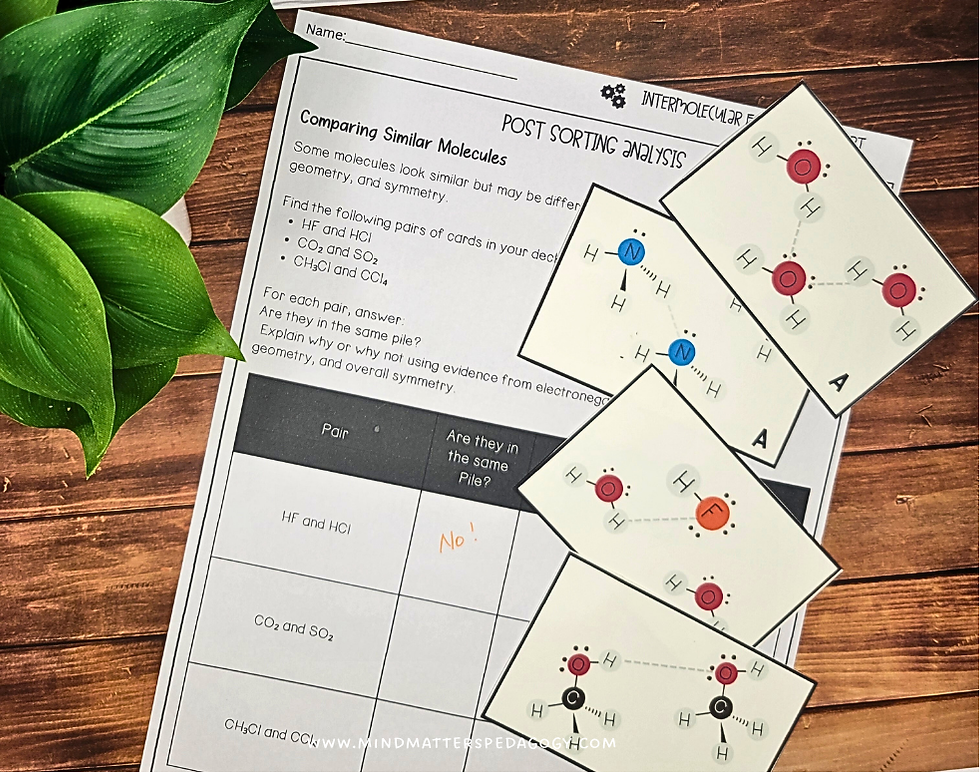
Read more about teaching intermolecular forces through comparison here: Why Intermolecular Forces Finally Make Sense When Students Can See the Attractions
Why This Bonding Sequence Works for Students
What ties this entire sequence together isn’t a single strategy or resource. It’s a consistent philosophy:
students reason before they memorize,
visuals and models come before abstraction,
practice follows understanding, not the other way around.
Over time, I’ve found that students retain more, rely less on guessing, and transfer their understanding more confidently to new situations.
Just as importantly, this approach gives teachers flexibility. You can slow down where students need it and move faster where they don’t — without losing coherence.

A Note for Busy Teachers
I know how unrealistic it can feel to rethink an entire unit while juggling labs, grading, and everything else that comes with teaching.
That’s why these ideas were developed incrementally — tested, adjusted, and refined over years in real classrooms. I eventually organized all of these ideas, activities, and sequences into a single Covalent Bonding → Structure → Polarity → Intermolecular Forces unit.
You don’t need to use every piece at once. Even small shifts toward making connections explicit can have a noticeable impact.
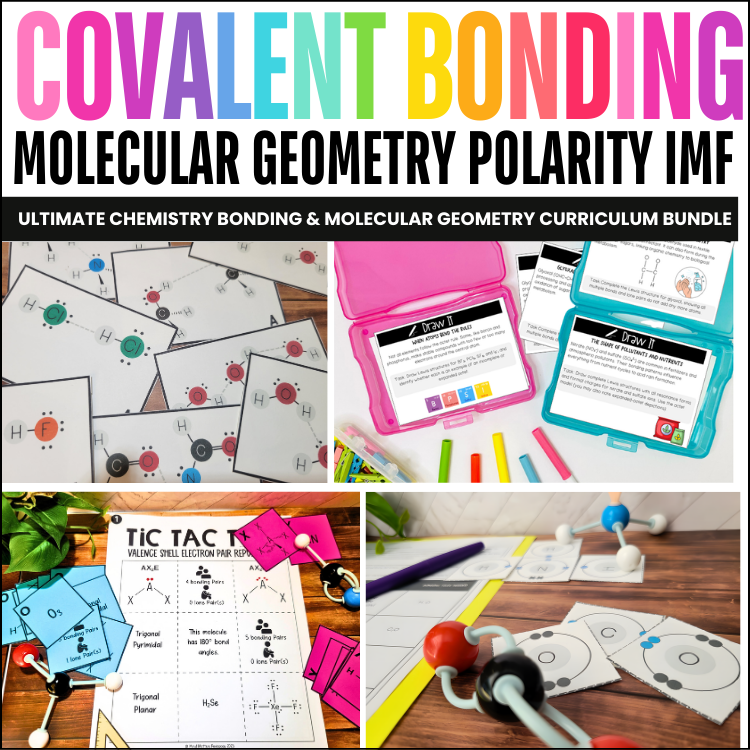
Some classes need more time with models. Others move quickly into application. The value of having the full sequence available is being able to respond to your students without losing the conceptual throughline.
If you’re looking for a way to teach bonding that feels intentional, connected, and grounded in how students actually learn, this full unit brings all of these pieces together.
Final Reflection
When bonding is taught as a connected system instead of a checklist of topics, students begin to see chemistry as logical rather than arbitrary.
They don’t just perform steps — they understand relationships.
And in my experience, that’s what makes learning stick long after the unit is over.
Grab Our Free Ebook:

Frequently Asked Questions About Teaching Chemical Bonding
Why do students struggle with chemical bonding?
Students often struggle because bonding topics are taught as separate units instead of as connected ideas. When students understand how electrons determine structure and structure determines properties, bonding becomes much easier to understand.
What topics are included in the bonding unit in high school chemistry?
Most bonding units include covalent bonding, Lewis structures, VSEPR molecular geometry, molecular polarity, and intermolecular forces.
What is the best order to teach bonding topics?
Many teachers find that the following sequence works well:
covalent bonding → Lewis structures → molecular geometry → polarity → intermolecular forces.


Comments