.png)

.png)


Molecular Geometry and VSEPR: A Visual and Tactile Approach

Updated: Jan 23
This post is part of an ongoing series on teaching chemical bonding as a connected system. Links will be added as each post is published.
How to Teach Covalent Bonding in a Way Students Actually Understand(Building electron-sharing intuition before rules)
How I Get Students to Actually Master Lewis Dot Structures(Scaffolding + real-world context, without guesswork)
Why Molecular Geometry Finally Clicks When Students Can See VSEPR(Moving from Lewis structures to 3D reasoning)
How to Teach Molecular Polarity Without the Guesswork(Bond polarity → shape → symmetry → reasoning)
Why Intermolecular Forces Make Sense When Students Compare(Turning IMF into the payoff, not another memorization task)
Stop Treating Molecular Geometry and VSEPR Like a Chart Students Have to Memorize
If VSEPR has ever felt like one of those topics students can temporarily survive—but not truly understand—you’re not imagining things.
On paper, molecular geometry looks straightforward: match a Lewis structure to a shape name, maybe memorize a bond angle or two, and move on. In my classroom, though, I’ve found that a lot of students are really just pattern-matching.
They remember that trigonal planar is “120°” or that tetrahedral is “109.5°” long enough to get through the assessment, but they’re not actually sure why the shape looks the way it does.
That gap shows up almost immediately when we transition into polarity or intermolecular forces — suddenly the memorized labels stop helping, and students aren’t confident explaining what the molecule is doing in space.
The problem isn’t VSEPR itself. It’s how abstract it feels when it lives only on paper.
Over the years, I realized that asking students to understand molecular geometry without ever seeing molecules in three dimensions is like asking them to understand anatomy from stick figures. They need depth. They need rotation. They need to build.
That’s when VSEPR stopped being a memorization exercise in my classroom—and became a spatial reasoning skill instead.

Why Molecular Geometry Feels So Abstract to Students
By the time students reach VSEPR, they’re already carrying a lot of cognitive baggage from earlier in the unit:
Lewis structures
electron domains
bonding pairs versus lone pairs
and the occasional, perfectly reasonable question about octet rule exceptions
On a worksheet, all of that information gets flattened into dots and lines. And when that happens, students do what students always do when something feels removed from reality — they default to memorization.
They can’t actually see electron repulsion. Lone pairs still feel like tiny dots that sit on an atom instead of regions of electron density that push everything else around them.
So rather than starting with a VSEPR chart and asking students to trust it, I change the sequence.
We visualize first. We build next. We name last.
That order mirrors how students learn spatial concepts in real life — not by memorizing labels, but by interacting with shapes.
From Lewis Dot Structures to Spatial Thinking
By the time we reach molecular geometry, my students aren’t starting from scratch. Earlier in the unit, they’ve already worked with covalent bonding manipulatives ( which you can read about here) , drawn dot‑and‑cross shell diagrams, and practiced translating those into what I often call “soft” Lewis structures or displayed formulas.
That groundwork matters more than it might seem. When students already understand where electrons come from and how they’re shared, Lewis structures stop feeling like an arbitrary set of rules and start functioning as an organizational tool.
(If that foundation sounds important, I unpack it more fully in Blog Post #2 in this series: How I Get Students to Actually Master Lewis Dot Structures)
When we transition into VSEPR, I’m not asking students to learn something completely new. I’m asking them to take something familiar and view it through a spatial lens.
This is usually the moment I pause and ask:
“You’ve drawn it — now what does this actually look like in space?”
That question sets the stage for everything that follows.
Using the PhET Simulation as a Visual First Step (Optional)

For some classes, I begin molecular geometry with the PhET Molecule Shapes simulation as a visual warm‑up.
I want to be clear about this: PhET is optional. I don’t use it every year or with every group. But when I do, it serves one specific purpose — helping students see electron regions repelling one another before they’re asked to manipulate physical models.
At this stage, I’m not asking students to name shapes or recall angles. I simply ask them to observe:
how bonds spread out as electron domains are added,
how lone pairs push bonded atoms closer together,
how geometry changes when electrons are toggled on and off.
For visual learners, especially, this reduces initial confusion. It gives students a mental picture to hold onto.
Once that picture is in place, we move from visual… to tactile.
Build‑It Modeling: Where Understanding Actually Locks In
This is where molecular geometry truly stops being abstract.
Once students have had a chance to see electron repulsion visually, I move into what I consider the most important part of this sequence: building molecules directly from Lewis structures using the Build‑It modeling cards and molecular modeling kits.

The molecules students start with are intentionally familiar and authentic — water, ammonia, carbon dioxide, methane then move on to slighlty more complex, but still relevant molecules.
There’s strong evidence in science education research that students reason more deeply when they work with real, recognizable molecules rather than generic placeholders.
When students recognize a molecule, they’re more invested in figuring out why it behaves the way it does.
At this stage, I give students the Lewis dot structures and one instruction:
“Build what the Lewis structure tells you to build.”
That’s it.
I don’t explain VSEPR rules yet. I don’t talk about shape names. I want the electrons to do the teaching.
Some molecular modeling kits like this one include lone‑pair electron pieces, and I use them whenever possible.
Those lone‑pair slices are incredibly powerful. They help students see that lone pairs aren’t decorative dots — they occupy real space and actively push bonding pairs away. This is often the first time that idea truly lands (If they haven't completed the PHet visual activity that is...) .
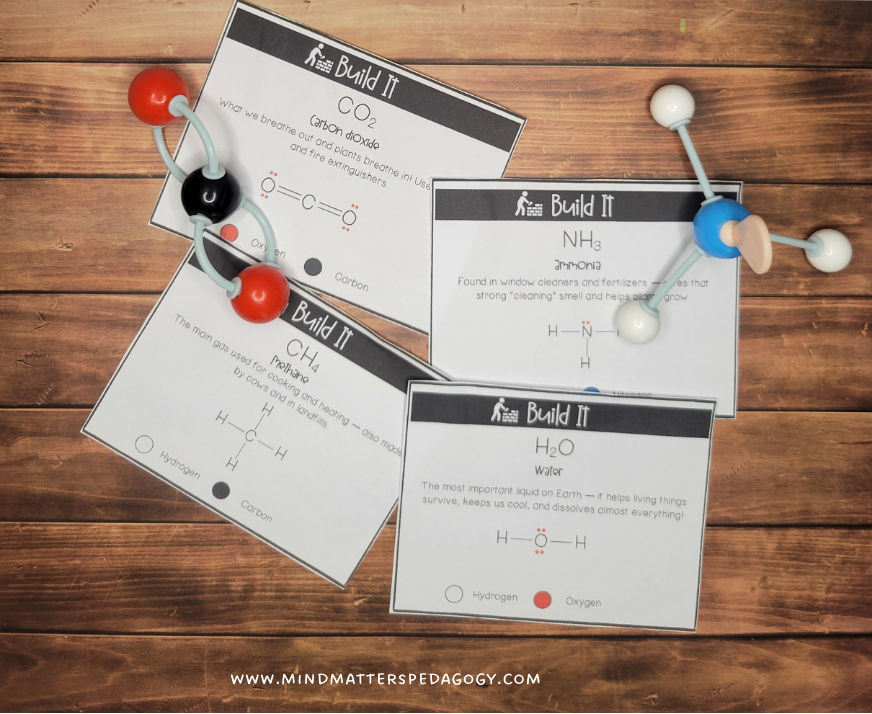
As students build, they rotate the models instinctively.
They turn them sideways, upside down, and inside out, trying to make sense of the shape. No one has to tell them to do this; spatial reasoning kicks in naturally once the molecule exists in their hands.
Only after that exploration do we begin naming shapes. And at that point, the vocabulary no longer feels random. Terms like linear, trigonal planar, tetrahedral, or bent become labels for structures students already understand.
This is when VSEPR truly starts to make sense, not because students memorized a chart, but because they’ve reasoned their way to molecular geometry through structure, space, and electron behavior.
Reinforcing Geometry Through Games and Talk
Once students have built and handled several models, this is usually the point where I bring out more traditional practice for reinforcement.
At this stage, worksheets actually work — because students now have a mental and physical model to attach the practice to (Check out this great set of VSEPR and molecular modelling worksheets) . The questions no longer feel abstract, and students are far less likely to guess their way through them.
Alongside that practice, I also like to use the VSEPR Tic‑Tac‑Toe game as a way to keep the reasoning active rather than passive.
VSEPR Tic‑Tac‑Toe
Instead of answering isolated questions, students justify matches using electron geometry, molecular geometry, bond angles, and Lewis structures.
Just as importantly, they explain why other options don’t work.
That kind of comparison is where misconceptions finally surface.

Guided Discussion
I regularly pause activities to ask questions like:
“Where are the lone pairs here?”
“How many electron domains do you actually see?”
“If this shape changed, what would that do to polarity later on?”
These conversations are short, informal, and incredibly revealing.
How VSEPR Naturally Sets Up Polarity
One of the biggest benefits of teaching molecular geometry visually is how smoothly it prepares students for polarity.
Once students have built both symmetrical and asymmetrical molecules, polarity stops feeling like a guessing game. They already expect to think about shape, balance, and cancellation of dipole. When we formally introduce molecular polarity, it feels like a continuation — not a new topic. (Check out my Polar Non-Polar Card sort if you're looking for a great bridging activity from VSEPR to Molecule Polarity)
Why This Sequence Holds Up Over Time
After over a decade of teaching this unit, what I’ve found is simple:
visual exposure reduces confusion,
physical modeling builds intuition,
terminology sticks when it labels understanding rather than replaces it.
Molecular geometry doesn’t need to be a hurdle in your chemistry curriculum.
When students can see molecules, build them, and reason through shape step by step, VSEPR becomes something they understand — not something they survive.
And once that foundation is in place, everything that follows — polarity, intermolecular forces, and chemical behavior — becomes far more intuitive.
Looking for some Made for resources?
If this approach to VSEPR resonates with you — starting with visual reasoning, moving into hands-on building, and only then naming shapes — you don’t have to piece it together on your own.

I’ve pulled these activities into a Molecular Geometry & VSEPR Theory Bundle that mirrors the exact progression I use in my classroom: visual → tactile → reasoning → reinforcement.
It’s designed to help students see molecular geometry, not memorize it — and to give you flexible entry points depending on your students’ needs.


Comments