.png)

.png)


How to Teach Intermolecular Forces So Students Actually Understand (Not Just Memorize IMF)

Updated: Mar 18
Why Students Struggle With Intermolecular Forces
Teaching intermolecular forces (IMF) is often the moment when a chemistry bonding unit suddenly becomes confusing for students.
I usually see it happen right after we finish covalent bonding. Students feel confident drawing Lewis structures, identifying molecular geometry, and determining molecular polarity. They’ve spent days thinking about what happens inside molecules.
Then the next lesson begins.
I write intermolecular forces on the board.
And suddenly the conversation shifts from bonds within molecules to the forces between molecules.
That shift is where many students start to feel lost.
Instead of building on the ideas they already understand, intermolecular forces are often presented as a list to memorize: hydrogen bonding, dipole–dipole interactions, and London dispersion forces. Students can usually remember the names, but when asked to explain why one force dominates in a substance, the reasoning often falls apart.
Over time, I realized the problem wasn’t the difficulty of the topic—it was the way the topic was framed.
In this post, I’ll show the approach I use when teaching intermolecular forces in high school chemistry by connecting them directly to concepts students already understand:
molecular polarity
molecular structure
electron distribution
molecular size and polarizability
When students see intermolecular forces as a consequence of molecular structure, the topic stops feeling like a random list of interactions and starts to feel like the natural final step in understanding chemical bonding.
This article is part of a series on teaching chemical bonding as a connected system, where students move from electron sharing to molecular interactions through a coherent reasoning pathway.
How to Teach Covalent Bonding in High School Chemistry:
Building electron-sharing intuition before introducing formal rules.
How to Help Students Master Lewis Dot Structures:
Scaffolding structure drawing with real-world context.
Teaching VSEPR and Molecular Geometry So Students Actually See Shape:
Moving from Lewis structures to three-dimensional reasoning.
How to Teach Molecular Polarity Without Guesswork:
Connecting bond polarity, shape, and symmetry.
Teaching Intermolecular Forces as the Logical Next Step:
Turning IMF into the payoff of bonding instead of another topic to memorize.
What Are Intermolecular Forces?
Intermolecular forces are attractions between molecules that influence physical properties such as boiling point, melting point, and solubility.
The three major types of intermolecular forces commonly taught in high school chemistry are:
London dispersion forces – temporary attractions caused by electron movement in molecules
Dipole–dipole interactions – attractions between polar molecules
Hydrogen bonding – a particularly strong dipole interaction involving hydrogen bonded to nitrogen, oxygen, or fluorine
Students determine the dominant intermolecular force in a substance by analyzing:
whether the molecule is polar
whether hydrogen bonding is possible
the size and electron distribution of the molecule
When students understand how these forces arise from molecular structure, IMF becomes much easier to reason about.
Intermolecular Forces Are the Logical Result of Molecular Structure
By the time we reach intermolecular forces, students actually already have the tools they need.
From earlier in the unit, they understand:
how electrons are shared in covalent bonds,
how Lewis structures act as representations of covalent compounds,
how VSEPR theory explains molecular shape,
and how polarity is a consequence of uneven charge distribution.
Intermolecular forces aren’t a new idea layered on top of those concepts. They are the consequences of them.
When students recognize that intermolecular forces explain what their molecules do, not just what they’re called, the topic stops feeling like another hurdle they have to overcome in their chemistry course.

Why Teaching Intermolecular Forces as Definitions Causes Problems
When intermolecular forces are taught as isolated categories, students naturally fall back on shortcuts.
I hear comments like:
“It has an O–H bond, so it’s hydrogen bonding.”
“This one’s nonpolar, so it must be London dispersion.”
What’s missing isn’t effort — it’s comparison.
Students need to see multiple molecules side by side and decide which attractions matter most and why. Without that contrast, IMF turns into another labeling exercise .
Why Comparing Molecules Helps Students Understand Intermolecular Forces

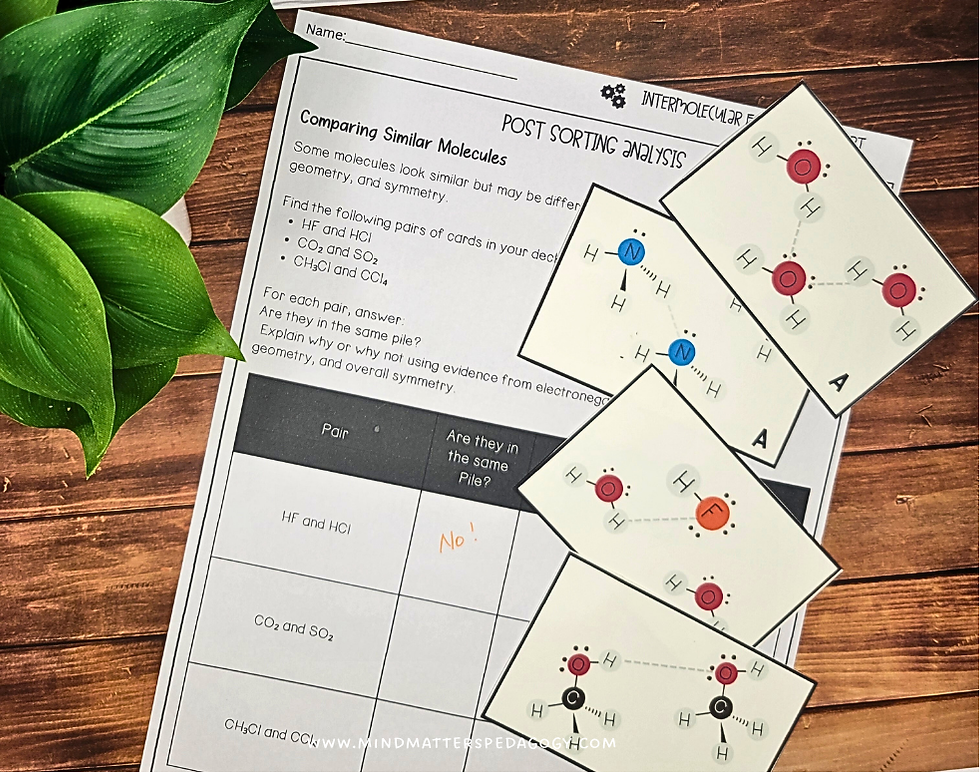
In my High School chemistry class, I approach the topic of intermolecular forces by running an intermolecular card sorting activity. For this activity, I use pairs or small groups. Each group gets a set of molecule cards and a simple prompt: sort these based on the dominant intermolecular force.
Instead of answering questions in isolation, students physically compare molecules. They place cards next to each other, debate dominant forces, and justify decisions out loud. In the process, misconceptions surface naturally — especially when two molecules share features but behave differently.
For example, students might compare H₂O and H₂S. Both molecules have a similar bent shape, but only water exhibits hydrogen bonding because hydrogen is bonded to a highly electronegative oxygen atom. Hydrogen sulfide, on the other hand, does not form hydrogen bonds and is dominated by dipole–dipole interactions and London dispersion forces.
This approach aligns well with what we know about learning:
visual representations support deeper understanding,
Comparing examples strengthens pattern recognition,
and reducing cognitive load allows students to focus on reasoning instead of recall.
Why Card Sort Activities Work Better Than Traditional IMF Worksheets
By the time we reach intermolecular forces, students are usually carrying a lot of cognitive baggage.
They’ve just worked through bonding, structure, shape, and polarity — and for many of them, those ideas are still settling. Handing out a full worksheet at this point, especially one packed with definitions and ranking questions, can feel like asking them to sprint when they’re still catching their breath.
I’ve learned this the hard way.
When students see a page filled with ten or twelve IMF questions, a good number of them shut down before they even start.
Because students handle one molecule at a time, the task feels manageable — even for students who typically struggle. No one is staring down a page full of questions, wondering where to start.
That’s where card sorts quietly do a lot of heavy lifting.

Reducing Cognitive Load During IMF Practice
With a card sort, the cognitive demand is spread out: one molecule at a time, one comparison at a time, one justification at a time.
Students aren’t trying to hold everything in their heads all at once. They’re making small, manageable decisions — and talking through them. That structure keeps the chemistry rigorous without making it feel inaccessible.
What I’ve noticed over the years is that once students have sorted, debated, and defended their choices, traditional practice suddenly becomes more productive.
When we return to questions about boiling point or dominant intermolecular forces, students aren’t guessing. They’re pulling from reasoning they’ve already rehearsed out loud.
Using Reflection to Assess Intermolecular Force Reasoning
After the sort, I always ask for a short written reflection — nothing long or formal.
Questions like:
Which intermolecular force is strongest in this substance, and why?
What evidence supports your conclusion?
These quick responses tell me far more than a multiple-choice question ever could.
You can immediately see who understands the hierarchy of intermolecular forces — and who is still relying on surface-level cues like “this one has hydrogen” or “this molecule is bigger.”
Just as importantly, students start to realize that IMF decisions aren’t about memorizing labels. They’re about weighing evidence.
When Intermolecular Forces Start Explaining Real Phenomena
This is the point in the unit where something really important happens.
Intermolecular forces stop feeling like abstract forces floating between molecules — and start explaining things students recognize.
They can now articulate why:
Water has an unusually high boiling point,
ethanol and acetone behave differently despite similar sizes,
Larger nonpolar molecules often boil at higher temperatures than smaller ones.
Those explanations don’t come from memorized charts. They come from comparison — from seeing patterns across molecules and defending conclusions.
That shift is subtle, but it’s powerful.
Key Idea: Intermolecular Forces Are the Consequence of Molecular Structure
Students understand intermolecular forces much more easily when they see them as the result of earlier bonding concepts.
Covalent bonding → Lewis structures → molecular geometry → polarity → intermolecular forces.
When this reasoning chain remains intact, intermolecular forces stop feeling like a list of definitions and start explaining real molecular behavior.
Final Thoughts
Intermolecular forces work best when they’re taught as the logical conclusion of bonding, structure, and polarity — not as a stand-alone list of terms tacked on at the end of the unit.
When students can see and compare molecular attractions, the topic becomes coherent instead of overwhelming.
And in my experience, that’s when students stop asking, “What category is this?”and start asking, “What’s really happening here?”
A Note for Teachers Looking for Structure Without Rigidity
If you’re looking for a way to teach intermolecular forces that builds on everything students already know — without adding more memorization — the Intermolecular Forces Card Sort is designed to support exactly this kind of reasoning.
It gives students space to compare, discuss, and justify before moving into traditional practice — and it fits naturally at the end of a well-sequenced bonding unit.


Frequently Asked Questions About Intermolecular Forces
What are the three main types of intermolecular forces?
The three most commonly taught intermolecular forces are London dispersion forces, dipole–dipole interactions, and hydrogen bonding.
How do you determine the dominant intermolecular force?
To determine the dominant intermolecular force, first determine whether the molecule is polar. Then check for hydrogen bonding. If neither applies, London dispersion forces are usually the dominant interaction.
Why do students struggle with intermolecular forces?
Students often struggle because intermolecular forces are introduced as isolated definitions rather than as the result of molecular polarity and structure.


Comments