.png)

.png)


The Most Foolproof Guide to Teach Lewis Dot Structures (Even If Your Students Hate Them)

Updated: Jan 23
This post is part of an ongoing series on teaching chemical bonding as a connected system. Links will be added as each post is published.
How to Teach Covalent Bonding in a Way Students Actually Understand(Building electron-sharing intuition before rules)
How I Get Students to Actually Master Lewis Dot Structures(Scaffolding + real-world context, without guesswork)
Why Molecular Geometry Finally Clicks When Students Can See VSEPR(Moving from Lewis structures to 3D reasoning)
How to Teach Molecular Polarity Without the Guesswork(Bond polarity → shape → symmetry → reasoning)
Why Intermolecular Forces Make Sense When Students Compare(Turning IMF into the payoff, not another memorization task)
Stop Rushing Lewis Dot Structures — Here’s What Actually Works
Lewis dot diagrams are one of those deceptively simple topics we tend to rush through — usually because we’re eager to get to things like VSEPR, molecular geometry, and polarity. On paper, Lewis structures feel basic. But in practice? They’re anything but.
If you’ve been teaching chemistry for a while (or studied it beyond high school), it’s easy to forget that you’re no longer thinking like a beginner. You don’t consciously count electrons anymore — you recognize patterns automatically. But...Your students haven’t developed that intuition yet.
A Repeatable System that Works
What finally changed things for me was realizing I didn’t need a clever analogy or a new shortcut. I needed a simple, repeatable system that respected how students learn:
heavy scaffolding to reduce overwhelm and build confidence
authentic practice using molecules that actually mean something
Those two moves completely changed how my students approached Lewis structures. But this this system only works because of what comes before it.
If you read my previous post on teaching covalent bonding using manipulatives ,you already know that my students spend significant time using my covalent bonding tiles, drawing dot‑and‑cross shell diagrams, and translating them into simple displayed formulas before we ever touch formal Lewis structures ( I strongly recommend you read this blog post).
By the time we begin learning Lewis structures, students aren’t learning something brand new — they’re simply organizing ideas they’ve already encountered, built upon, and made sense of.
Nothing feels foreign. Nothing feels rushed. We’re just putting language to understanding that’s already forming.

The Scaffolded Steps I Use to teach Lewis Dot Structures (And Why They Work)
When students are first learning Lewis structures, I don’t expect them to keep everything straight in their heads. So I don’t ask them to.
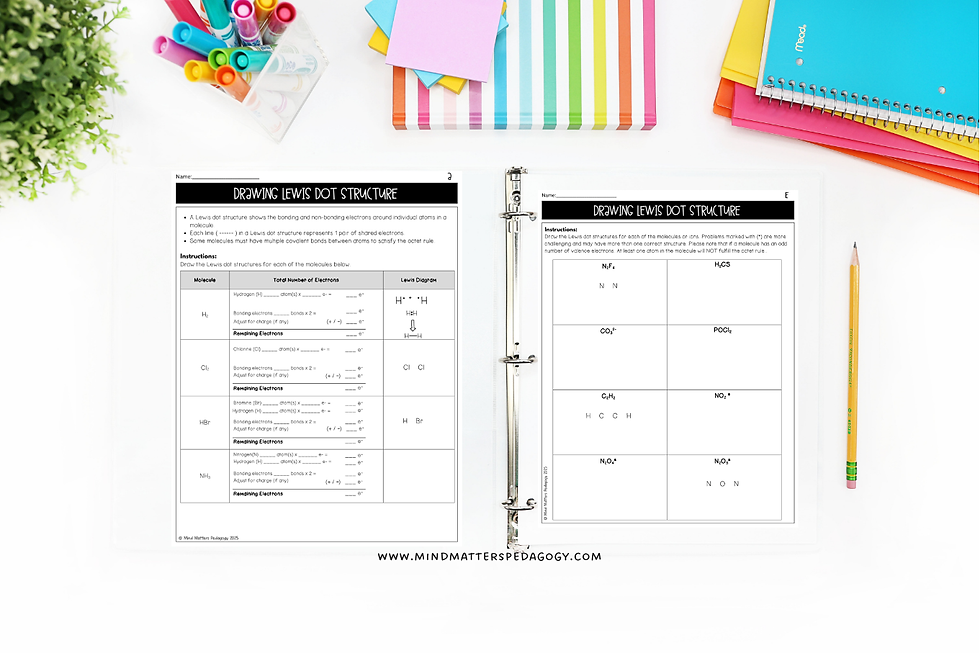
I give them a step‑by‑step guide that lives directly on the first few worksheets. Students can literally track where electrons are coming from and where they are going, instead of guessing.

As students gain confidence, that scaffolding gradually disappears. For students who don’t need it, I always include an unscaffolded version as a built‑in differentiation option.
Here’s the exact sequence students follow when they’re starting:
Step 1 — Add Up Valence Electrons
We always start by accounting for electrons.
Students add the valence electrons for all atoms.
If the species is an ion:
negative charge → add electrons
positive charge → subtract electrons
This step anchors everything that follows. Students know exactly how many electrons they are allowed to use — no more, no less.
Step 2 — Choose the Central Atom (Using Logic, Not Guessing)
We talk explicitly about how to decide this:
The least electronegative atom (except hydrogen) usually goes in the center.
Hydrogen and halogens almost never sit in the middle.
Alternatively, students can decide which atom needs the most bonds based on valency. I use this approach If we haven't discussed electronegativity yet.
On the very first scaffolded worksheets, I give students the central atom to reduce cognitive load. Once they’re comfortable, that support is removed — and they make the decision themselves.
Step 3 — Connect Atoms With Single Bonds
Students draw single bonds between the central atom and surrounding atoms.
Each bond represents 2 shared electrons ( we already learned all this during the Introduction to Covalent Bonding Activity using the bonding tiles)
Students subtract these electrons from their total.
This step gives students an immediate visual structure — and a sense of progress.
Students get more practice with this with the Draw It (In Context) Task Cards.
Step 4 — Complete Octets on Outer Atoms
Next, remaining electrons are distributed to outer atoms:
Octets for most atoms
Duets for hydrogen
Students can see electrons being placed instead of hoping they end up in the right spot. We do this
Step 5 — Place Leftover Electrons on the Central Atom
If there are still electrons left after you’ve filled the outer atoms, this is when students pause and ask, “Okay… now what?”
Those leftover electrons go on the central atom. And this is usually where some really important conversations happen.
Students start noticing that not every atom plays by the same rules:
some atoms are perfectly happy with less than an octet (like boron)
others can handle more than eight electrons (like sulfur or phosphorus)
This is often the first time students realize Lewis structures aren’t about forcing everything into a rigid template. They’re models — flexible ones — that help explain how electrons actually behave.
**Step 6 — Form Double or Triple Bonds **Only If Needed
If the central atom still doesn’t have a full octet, students have to pause and think:
Where could these electrons come from?
Which lone pairs could be shared instead?
That’s when they start converting lone pairs on outer atoms into bonding pairs and forming double or even triple bonds — not because I told them to, but because it’s the only move that makes sense.
I don’t introduce multiple bonds as a rule to memorize. I let students discover why they’re needed.
And once students have worked through this sequence a few times, something important happens. They stop asking, “What step comes next?” and start asking, “Does this structure actually make sense?”
Lewis Dot Structures in Context: Where Real Understanding Happens
After students have practiced the scaffolded steps and built up confidence, I shift them into an activity I call Draw‑It Task Cards. These are not typical worksheet questions. Instead, each card presents an authentic molecule — the kinds of structures students actually encounter in real chemistry:
amino acids,
atmospheric pollutants,
simple pain relievers,
everyday organic molecules.

Sometimes students get a full skeletal outline and must complete the Lewis dot structure. Other times, they’re given clues — formula, functional group hints, or partial diagrams — and they must deduce the structure themselves. This pulls students out of “worksheet mode” and into genuine reasoning.
Why These “Real Molecule” Tasks Work (What the Research Says)
There’s a lot of solid pedagogy behind this approach — more than you might realize.
Authentic tasks increase cognitive engagement
Studies on context-based chemistry instruction consistently show that students reason more deeply when problems feel connected to the real world. They remember structures better, ask stronger questions, and make more accurate predictions about properties.
A molecule like ethanol or CO₂ is familiar. It lives in their world. That familiarity reduces abstraction and spikes interest.
Molecules in context:
activate prior knowledge,
improve transfer of learning,
reduce abstraction fatigue,
encourage students to ask more sophisticated questions.

Scaffolding + context = stronger mental models
Research also tells us that scaffolding isn’t enough on its own. Students need chances to apply their skills to situations that matter.
My Draw-It Task Cards hit that sweet spot:
enough structure to prevent overwhelm,
enough novelty to require actual reasoning.
Students start constructing meaning, not just following steps.
Task cards reduce overwhelm compared to full worksheets
This is one of the sneaky benefits teachers don’t always realize.
When a struggling student sees a full worksheet of 12 structures, their brain goes straight to Nope. But one card? One molecule?Totally doable.
Task cards break the cognitive load into bite-sized decisions — and this is why they work so well for mixed-ability classrooms.
How I Use Them in My Classroom
By this point, students have already:
built molecules with covalent bonding tiles, and
drawn dot‑and‑cross shell diagrams,
translated them into “displayed formulas,”
and developed an early intuition for bonding (thanks to the Week 1 approach from my previous blog post).

Because of that foundation, some of my classes skip the scaffolded worksheets entirely and jump straight into the Draw‑It Task Cards.
Other classes still benefit from a mix: a little scaffolding first, followed by context cards once they’re steady.
Either way, these task cards are where students start making the connection between paper chemistry and real chemistry — and honestly, that’s my favorite part of the entire unit.
It’s also the point where I can step back a little. Students are no longer asking me if they’re “doing it right.” They’re checking their own work, comparing structures, and defending their choices with actual chemical reasoning. That’s when I know the foundation is solid.
Want to Use This Approach in Your Classroom?

If you want to try this approach in your own classroom, I’ve packaged both the scaffolded worksheets and the Draw-It task cards into a ready-to-print mini-bundle. It’s the exact sequence I use, and you can jump in at whichever point your students need most.
No stress, no reinventing, just meaningful practice that works.
Moving Into Molecular Geometry and Polarity
In my next post, we’ll build on everything from this post as we move into molecular geometry and polarity — where the shapes students draw finally become the shapes they can see.
VSEPR is where their earlier intuition really pays off, and I’ll show you exactly how I introduce shape, symmetry, and polarity in a way that feels natural and connected.


Has anyone else noticed how different no deposit pokies offers can be once you read the conditions? I recently came across the phrase free $100 pokies no deposit sign up bonus australia and it made me curious free $100 pokies no deposit sign up bonus australia about what normally comes with these promotions. The amount sounds appealing, but I’d want to know whether the bonus can actually be withdrawn, what wagering rules apply and whether certain games are excluded. The headline figure doesn’t really tell you much without that information.